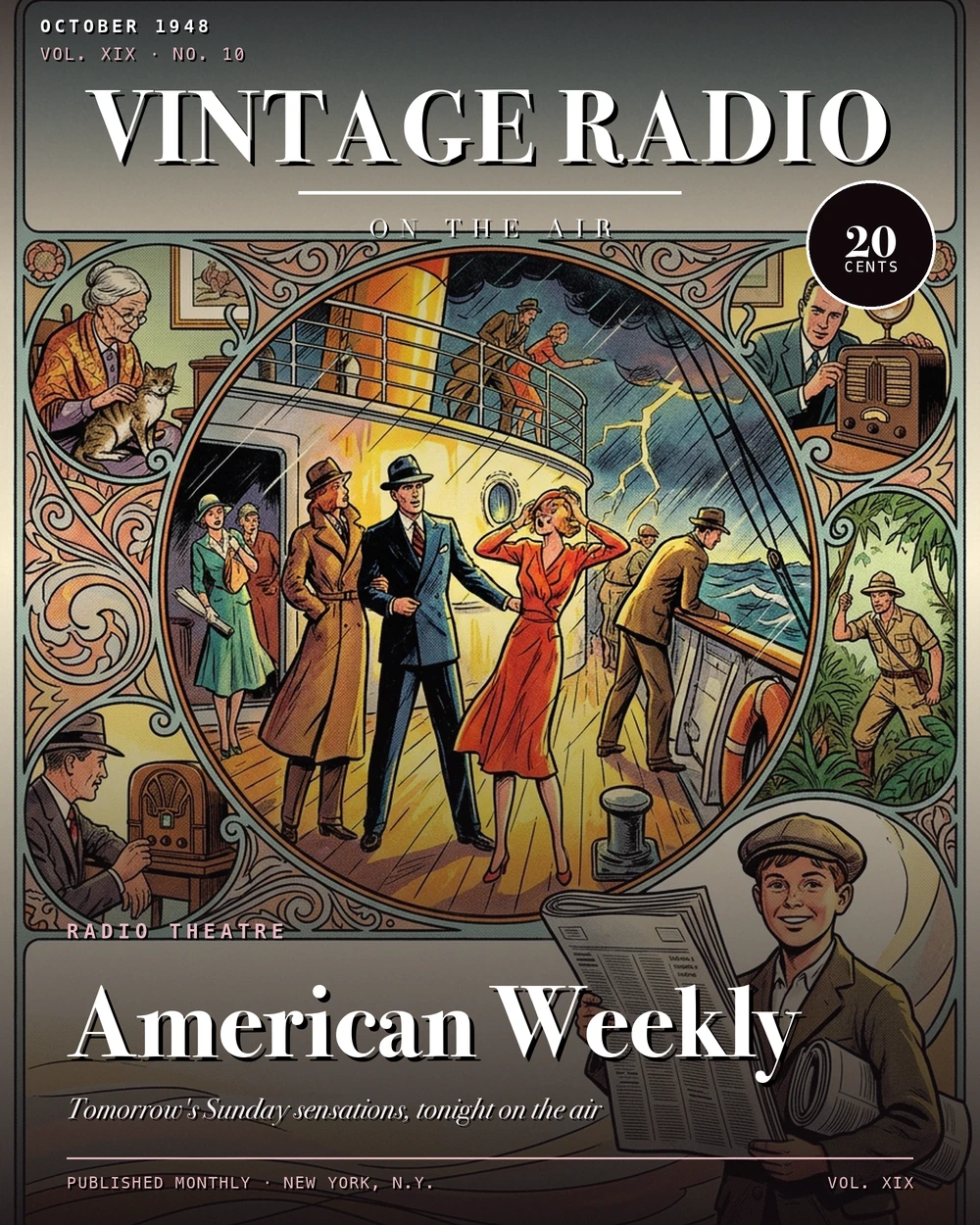
American Weekly
A Magazine on the Air
The idea behind American Weekly was straightforward and a little clever: give radio listeners a dramatic taste of the stories they'd find in Sunday's newspaper before the paper ever landed on their doorstep. The Hearst newspaper chain syndicated the series as a direct promotional vehicle for its American Weekly magazine supplement — the Sunday insert distributed coast to coast inside Hearst-owned papers, which claimed a circulation of over 50 million readers. Each roughly 15-minute episode dramatized a story from the forthcoming issue of the magazine, turning the broadcast into an extended advertisement dressed up as entertainment.
The programs were produced at the General Broadcasting Company's studios in New York City. Airing in syndication rather than on a single national network, the series never had the reach of a CBS or NBC flagship, but that wasn't quite the point. It existed to sell newspapers, and it built its audience on the same material the magazine was known for: sensationalized true-life accounts, mysteries, crimes, and the occasional speculative scenario — stories with enough pull to make a listener want the full version in print.
What Was Actually in the Episodes
The surviving episode titles give a fair sense of the range. "The Almost Perfect Crime" and "Venus in Furs" pointed toward mystery and lurid drama. "Wild West of 1933" blended nostalgia with contemporary framing. "When the Comet Strikes" ventured into speculative territory — a comet hitting Earth — which fit squarely in the magazine's tradition of sensationalized science and human-interest fare. These weren't literary adaptations in the traditional sense; they were dramatized versions of the kind of true-life and sensational stories Hearst had been publishing since 1896.
Each episode also carried a commercial hook running alongside the story itself. Listeners were teased at the top of the program with a mystery product to be revealed at the end — "twelve minutes of waiting now may mean a lifetime of comfort – listen for it at the end of the program." That second layer of engagement kept ears tuned past the closing scene, ensuring the sponsor's message landed.
The Short Run of the American Weekly Name
The title American Weekly applied only to the first 36 broadcasts, running from April 27, 1933, through January 4, 1934. The full on-air title was "The American Weekly Program: Front Page Drama," and after those initial programs the series continued under the name Front Page Drama alone — running, in that form, all the way through 1953. What survives under the American Weekly label, then, is a brief early chapter of a much longer program.
The director of those early episodes was Paul W. Keyes, who later built a significant television career — writing and producing for Dean Martin's variety program, serving as head writer on Laugh-In, and working as a consultant for Richard Nixon. At the time of American Weekly, he was near the beginning of that path, directing short syndicated radio dramas for the Hearst organization.
At least eight recordings from the American Weekly run are known to survive, with a combined running time of just over two hours — a modest but real remnant of what the series sounded like in those first months on the air.